How the studio posts while everyone sleeps
Telemetry in, receipts out — anatomy of an autonomous content pipeline.
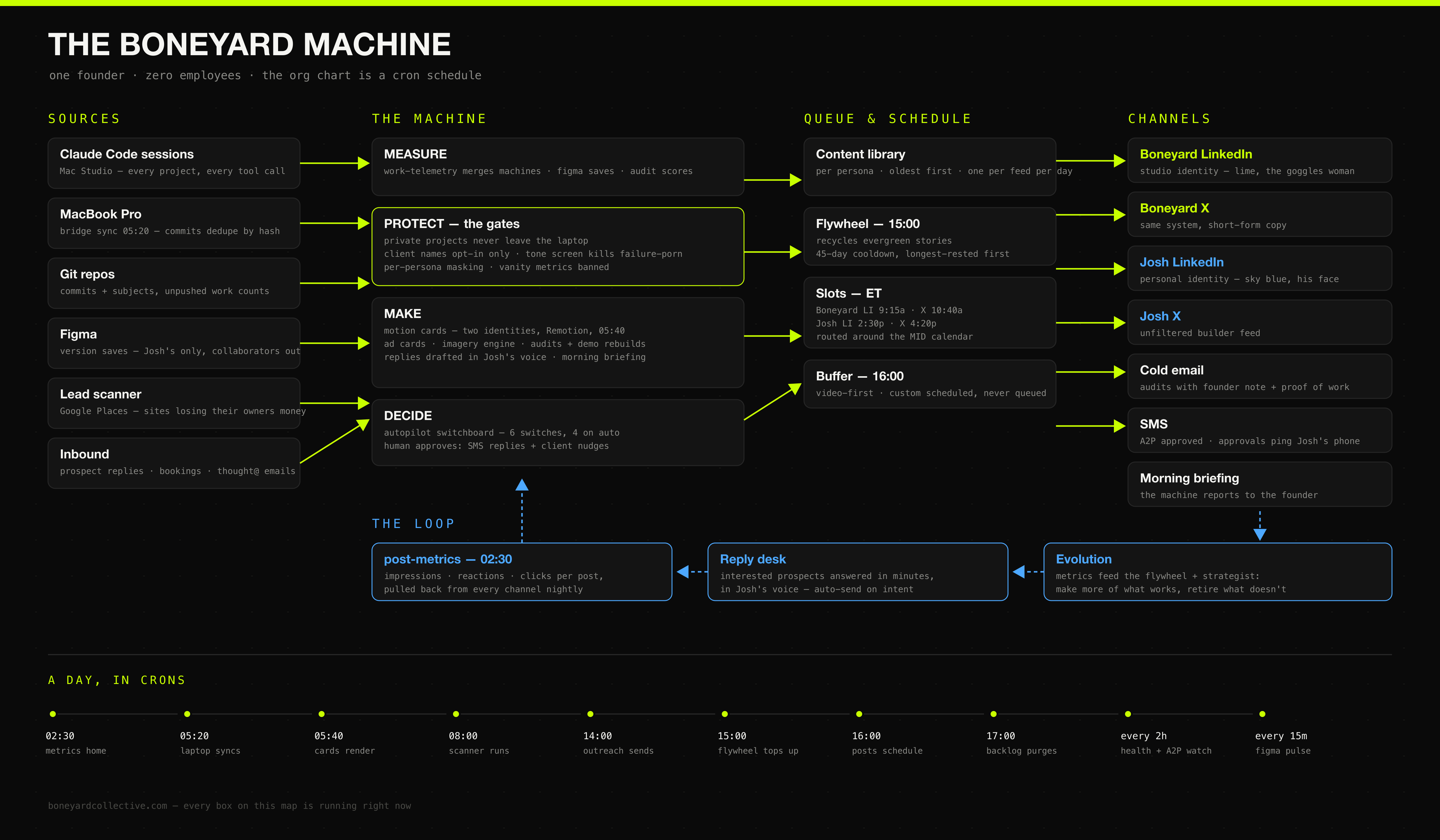
Every weekday morning at 9:15, our studio posts to LinkedIn. Nobody is awake for it. The card it posts — a motion graphic of yesterday's work, drawn from real telemetry — was rendered at 5:40 that morning by a scheduled job, from data nobody typed, through design nobody adjusted, on a schedule nobody confirmed. This article is about how that works, because "we automated our socials" is a sentence that hides all of the interesting parts.
Measure, don't describe
The pipeline starts with a refusal: nobody writes a daily status. The development environment already records every session — which projects were open, which tools ran, when commits landed. A telemetry reader reduces a day of that to a handful of honest numbers: commits, active hours, a read-to-write ratio, a per-hour distribution. Design work arrives the same way, counted from version saves. If the founder works from a second machine, its day syncs over and merges, deduplicating commits by hash so nothing counts twice.
The refusal matters because measured numbers survive being read by a stranger. "Nineteen hours of work" is a claim; "57 commits, first at 00:46, last at 23:59" is a record.
The gates are the product
Between measurement and publication sits the layer we consider the actual product: the gates. Private projects are excluded at the source — not masked, removed, because a masked name still discloses that something exists. Client names require recorded consent before they can appear anywhere; withdrawal removes them from the next send automatically. A tone screen drops commit messages that read as incident reports — the work still counts in the totals; the card just leads with output. And every project name passes a per-feed check, because a project can be public on one channel and private on another.
An autonomous publisher without gates is a liability generator. The gates are why this one gets to run unattended.
Two identities, one grammar
The studio publishes under two visual identities. The studio's cards are industrial — condensed type, hard bars, a classical figure in cloud goggles, lime on black. The founder's cards are a profile — his actual photo, sky-glow blue, the day drawn as breathing dots. Same motion language, same honest numbers, different worlds — so a half-second of scroll tells you whose card you're looking at before you've read a word.
Even the imagery on this page follows that split. It was generated by the studio's own engine: procedural scenes — monoliths for the studio, skies for the founder — run through glyph fields, ordered dithering, film grain and point lights. New frames for every piece, no stock, no prompts to a third party.

The queue thinks in stories
Publishing runs one post per feed per day into fixed slots, spread so two of our posts never crowd one hour. Daily cards are perishable — yesterday happens once. But essays, ads, and behind-the-scenes posts are stories, and stories recycle: when the queue runs low, the system requeues whichever evergreen story has been off the feed longest, after a 45-day rest. A feed's audience is a moving river; a story from July has never been seen by whoever arrived in September.
The loop
Every night the system pulls performance for everything it has ever published — impressions, reactions, clicks — back into its own database. That record steers what gets made more. Replies come back through the same door: an interested prospect gets an answer drafted in the founder's voice within minutes, and the conversations that need a human ping his phone.
The result is a company where the org chart is a cron schedule: measurement at 2:30, sync at 5:20, rendering at 5:40, recycling at 15:00, publishing at 16:00. One human, reviewing — and building whatever comes next while the machine carries the storefront.
We build systems like this for clients. The feed is just the one you can watch working.
Keep reading
More from the Journal
Studio
What Founders Actually Need From a Design Partner
Founders do not need more ceremony. They need clarity, speed, judgment, and a partner who can help turn ambiguity into shipped work.
Design
Why Great Websites Still Fail to Convert
A polished website can still underperform. The gap is usually not visual quality but clarity, structure, trust, and intent.
Design
The Difference Between a Pretty Website and a Useful One
Visual polish matters, but usefulness is what makes a website worth the investment. The best sites earn attention and create momentum.